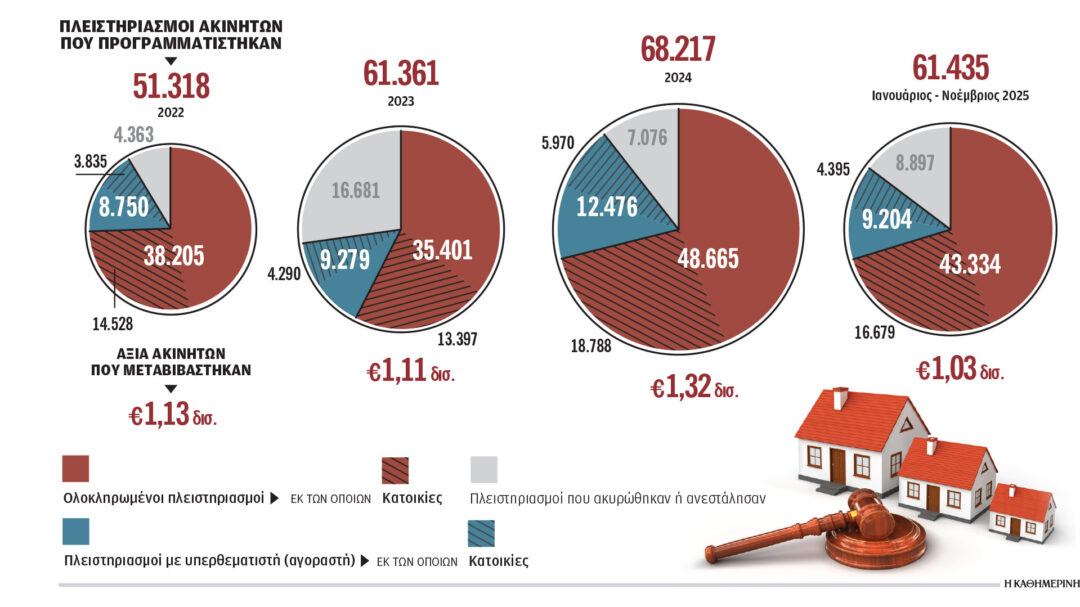
Buying real estate through an electronic auction has evolved into a popular investment method in Greece. Although the process offers opportunities to acquire properties at prices often lower than market rates, it requires proper preparation, legal due diligence, and strict adherence to deadlines. In this guide, we will analyze all the stages in detail, from registering on the platform to the final awarding of the property.
1. Preparation and Research (Before Registration)
Before you even decide to participate, you must know what you are buying. Auctions are conducted on an "as-is" basis, meaning the responsibility for the condition of the property rests solely with the buyer.
- Platform Search: All auctions are posted on eauction.gr. There, you can see the starting bid price, the date, and the time of the auction.
- Legal Due Diligence: It is essential to hire a lawyer to check the title deeds, encumbrances (mortgages, pre-notices), and any pending legal claims.
- Technical Inspection: An engineer should examine the posted appraisal report to identify any urban planning irregularities. Note that visiting the interior of the property is usually impossible unless the debtor agrees.
2. Registration on the eauction.gr Platform
Participation is conducted exclusively electronically. To have the right to submit a bid, you must be a registered member.
- Visit eauction.gr and select "Register."
- Log in using Taxisnet credentials for automatic identity verification.
- Fill in additional details (phone, email) and select your status (Natural or Legal Person).
- Accept the system's terms of use.
3. Application for Participation and Deposit of Guarantee
Once you find the property that interests you, you must submit an application for that specific auction code.
The Guarantee Deposit (30%)
To be eligible to participate, you must deposit a guarantee equal to 30% of the starting bid price. Additionally, a small "usage fee" (usually €15-20) is paid.
Deposit Methods:
- Transfer to a special notary account (via e-banking).
- Issuance of a bank guarantee letter.
- Deposit of a cashier’s check with the notary.
4. The Auction Day
Auctions are typically held on Wednesday, Thursday, or Friday. The process lasts two hours (e.g., 10:00 - 12:00 or 14:00 - 16:00).
The Bidding Process
Everything happens in real-time. Each participant sees the current highest bid (without seeing the names of the others). If a bid is placed in the last five minutes, an automatic five-minute extension is given (this can be repeated multiple times until bids stop).
| Status | Action |
|---|---|
| Open | You can submit a bid based on the defined "step" (minimum increment). |
| In Extension | A "bidding war" takes place in the final minutes. |
| Closed | The process is completed, and the announcement of the highest bidder is awaited. |
5. After the Auction: What Follows?
Case A: You are not the highest bidder
If you do not win the auction, your guarantee (the 30%) is returned in full to the bank account you declared, usually within 2-3 business days.
Case B: You are the successful bidder (winner)
Congratulations, but your obligations have just begun:
- Payment of Balance: You have a deadline of 10 business days to deposit the remaining 70% of the amount.
- Payment of Expenses: You must cover the Transfer Tax (3%), the notary's fee, and the registration fees at the Land Registry.
- Award Report: The notary prepares the report, which serves as your official title deed.
6. Common Mistakes and Risks
Participating without a strategy can lead to financial losses. Watch out for the following:
- Over-excitement: Do not exceed the limit you have set. Often, the heat of the moment leads to bids higher than the actual value of the property.
- Non-payment: If you are declared the winner and do not pay the balance, you lose the guarantee (30%) and may be called to cover the difference if the property sells for less in a subsequent auction.
- Occupancy by the debtor: After the award, if the previous owner refuses to leave, you will need to start an eviction process through a court bailiff, which requires time and extra costs.
How eAuction24.gr Transforms the Process
While the official state platform is used for the technical submission of bids, eAuction24.gr acts as an invaluable partner for the prospective buyer, offering tools that the official system lacks. See how it can help you gain an edge:
1. Smart Search and Filtering
Instead of searching through endless lists, eAuction24.gr allows you to find properties based on specific criteria that truly interest you:
- Geographic Location: Maps that show exactly where the properties are located.
- Categorization: Separation by type (residences, plots, commercial spaces).
- Alerts: The ability to receive notifications as soon as a property matching your filters is posted.
2. Complete Property File (Data Enrichment)
eAuction24.gr does more than just list the price. It collects and organizes all available information, saving you hours of research:
- Immediate access to appraisal reports and auction documents.
- Photographic material and property history.
- Information about the area and objective tax values.
3. Support from Specialized Consultants
Perhaps the most significant advantage is human guidance. The eAuction24.gr team provides:
- Legal and Technical Coverage: Connection with lawyers and engineers who understand the particularities of auctions.
- Bidding Strategy: Advice on the "ceiling" of a bid based on the market, so you don't pay more than the property is worth.
- Process Management: Help with registration and the deposit of the guarantee, reducing the risk of disqualification due to formal errors.
Conclusion
Electronic auctions are a transparent but rigorous process. Success is determined by preparation. Collaborating with an experienced lawyer and engineer is not just advice; it is a necessity to ensure that the "opportunity" you found does not turn into a legal or financial nightmare.